TIP! – How do you calculate the ROI of your event in practice?
ROI stands for the return on investment of your event, expressed as a percentage of the total costs of your event. But how does this work in practice and how do you calculate the ROI of your event?
In a mathematical formula, ROI is expressed as follows:
ROI = (value created – costs incurred) / (costs incurred / 100)
For a commercial company, you can easily express the value created in terms of financial return. For associations, this is often more difficult, but they can calculate the ROI for their sponsors or the impact on others. For example, the introduction of new and cheaper treatments for cancer patients at a medical conference will have a positive impact on the expenditure of health insurers.
ROI MODEL
The ROI methodology, which originated from the research models of Donald Kirkpatrick and Jack Phillips, has been refined over the years and, when applied to events, comprises the following levels:
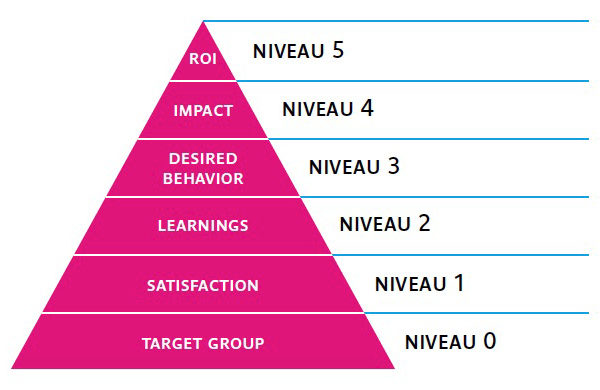
The highest level (ROI, level 5) has already been described above. The level below that (impact, level 4) indicates the ultimate value creation. If the goal of your event was to increase sales, then the impact will correspond to the ultimate conversion in sales, or revenue.
Level 3 represents the objectives of the desired behavior, i.e., the behavior needed to achieve the desired impact. That behavior could be an "information request," such as downloading a brochure or starting to use more recyclable materials following a CSR conference. Or you may want your participants to stop doing something, such as reducing spending as part of a cost-cutting exercise.
Level 2 contains the learnings (or learning objectives): what do you need to teach your participants in order to achieve behavioral change? This could be information or knowledge, but it could just as easily be about teaching skills.
Level 1 is all about satisfaction. What is needed to make the attendees feel comfortable? How do you create the right environment in which the learnings can be optimally conveyed? Think of obvious things such as decoration, catering, etc., but also the temperature and the structure of the program.
At level 0, we find the target audience. This is the last step, but certainly not the least important one. Later in this chapter, I will discuss determining your target audience in more detail, but keep in mind that in order to increase the ROI of your event, it is extremely important to only invite people who are relevant to the higher levels of the pyramid. This goes without saying, but all too often this simple rule is broken. We invite people because we know them and we think they belong, but in reality we already know in advance that they will not contribute to the ROI of your event.
Before you start working with the model, it is important to identify all your stakeholders (participants, speakers, sponsors, etc.). For each target group, formulate the objective according to the ROI pyramid from top to bottom (levels 5, 4, 3, 2, 1, 0) so that after the event you can measure from bottom to top based on the formulated objectives.
MEASURE
In order to measure effectively, it is important to isolate the effects you want to achieve from environmental influences as much as possible. For example, do not plan a large-scale advertising campaign at the same time as your event. This makes it very difficult to determine which channel convinced your customer. It goes without saying that advertising and events can complement each other. It may be your strategy to plan them together, but then it is best to measure the ROI of the two together. Working with a control group is also an option. For example, you could choose not to invite part of your target group, so that you can compare their (purchasing) behavior after the event with that of those who did attend.
CREATING VALUE
You have formulated a goal and you can measure it. Great! But unfortunately, that does not always mean that you are effectively creating value with your event. Value is created when you can bring about a change in behavior among your participants. So you need to ask yourself who you want to see change their behavior and how.
I cannot express the concept of value creation any better than Rob Captijn, a champion of calculating ROI on events. He outlines the story of supermarkets that, based on various studies and scientific research, have learned to influence consumer buying behavior so that they invariably leave with a fuller cart than they had originally planned. What the supermarket does with the strategic placement of products and offers, you can also do at your event with lighting, music, decoration, catering, etc. It is not enough to book a number of fun acts one after the other based on your gut feeling; it is about enticing your target group to change their behavior. It is about turning their "no" into a "yes."
Three elements determine whether you will succeed in creating the desired behavioral change:
- Sense of urgency. Your target group must recognize the urgency of the change. Otherwise, there will be no incentive to actually make a purchase or request information after the event.
- Relevant arguments. If you know your target audience and what they think of the goal, you can formulate convincing arguments to bridge the gap between "no" and "yes." That is why storytelling is indispensable for every event. Through careful editing of your event (choosing the right speakers, acts, etc.) and smart programming, you can encourage behavioral change.
- An event is the only marketing channel that can appeal to all the senses to convince your target audience. If you play your cards right, you can communicate extremely efficiently, powerfully, and with impact. It is no coincidence that 'experience' has become central to the organization of events.
- Activation. Everything you have built up with your event will be in vain if you don't have a safety net to activate your participants. In concrete terms, you need to provide a way for them to say 'yes, I do'. You can do this by giving them an order form, but also by asking for feedback on the spot. It is also this step that, if you do it right, makes the return immediately measurable.
Creating value doesn't just happen at the event itself. You continue along the same lines during the invitation process and after the event. Using the right media, the design and content of your event website... everything plays a part. For example, during registration, you can already ask for information that you will need later on, and after your event, you can use photos that you share on social media to convince the last few guests to attend.
Focus on the most promising target group for behavioral change. In other words: the target group that you can convince with the least effort and that will yield the highest return. This way, you will achieve your goal with less expense and fewer disappointments. What's more, you will still have room in your budget to tackle the hard nuts in your target group with specific actions at a later stage.
Source: article from eventplanner.nl